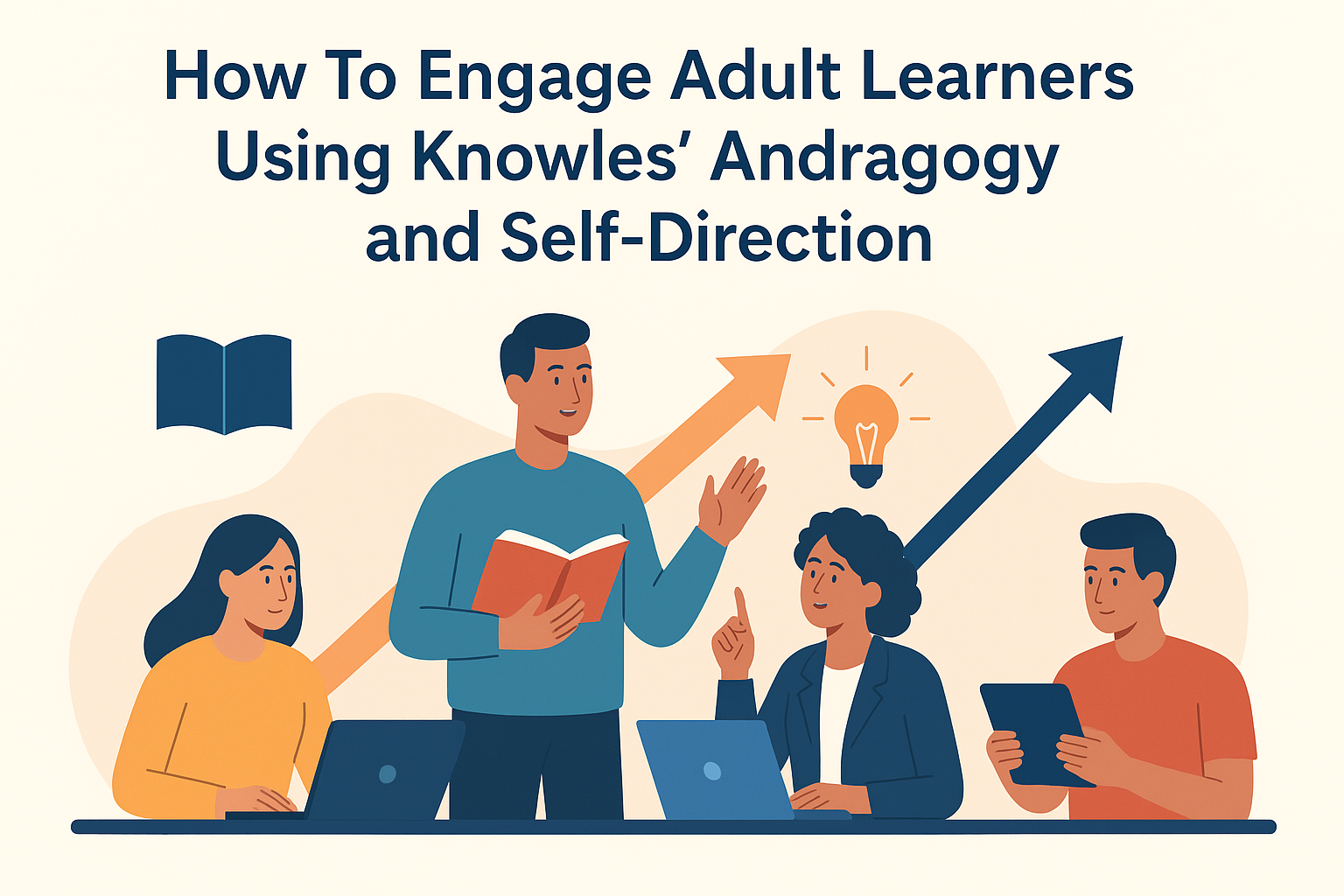
According to Knowles, adult learners are naturally self-directed. They are primarily in charge of organising, carrying out, and assessing their own learning process. Contrasting to traditional teaching in which all learning activities are guided by the instructor.
Malcolm Knowles, who is considered the founder of the andragogy approach—the art and science of assisting adults in learning—is closely linked to the idea of self-directed learning (SDL) for adult learners.
Andragogy can be likened to a GPS that directs an adult learner on a journey. The GPS (learner), being aware of their destination (what they wish to learn), selects the route based on prior knowledge gained from previous travels, will modify the course in response to the state of the road (immediate life needs), and thus, guides themselves toward their objective without continual guidance from an instructor (self-direction).
Pedagogy, on the other hand, involves a teacher guiding the student through the entire process, much like a tour guide. The teacher-led curriculum is typical of children’s education. Instead, andragogy essentially helps adults guide their own learning journey with assistance that is specific to their experiences and motivations.
Adult learning, or andragogy, focuses on how adults and children learn differently. Andragogy stresses self-directed learning, where adults take charge of their own education, as compared with pedagogy, which is focused on teaching children. The main concepts underlying andragogy are that adults learn best when they can apply what they learn to real-life issues, comprehend why they need to learn something, and draw upon their prior experiences.
For trainers and Learning & Development (L&D) professionals, the idea that andragogy helps adults guide their own learning journey with advice specific to their experiences and motivations is essential for a number of reasons.
- Creating training that respects adult learners’ autonomy will boost motivation and engagement while empowering adult learners. This empowers them to take charge of their education using a learner-centered approach.
- Adults have a lot of life experience that can be a great learning tool. Trainers must use prior experience-based training activities such as case studies, conversations, and problem-solving activities to integrate adults’ experiences into the learning process.
- Since adults are driven to learn items that are immediately applicable to their lives, learning and development (L&D) professionals should follow an application and relevance approach to match content to real-world issues and situations that learners encounter in their jobs or personal lives.
- Facilitation over teaching methods develops the ability to think critically and solve problems. Rather than merely imparting knowledge, trainers take on the role of coaches or facilitators, helping students find their own knowledge and abilities.
- Design interventions that appeal to the internal motivations and readiness of adult learners with the knowledge that certain motivations include job requirements, personal development, and professional advancement.
- Adult learners require flexibility in terms of learning pace, forms, and schedules through a range of learning opportunities, including self-paced courses, blended learning, and group projects.
In conclusion, L&D professionals and trainers can maximize the efficacy of adult education and professional development when adopting the concepts of andragogy to engage adult learners to stick with their learning process. This means creating and delivering learning experiences that are individualized, relevant, and empowering. As a result, the learning outcomes are more significant and long-lasting.
Further reading:
Maestro. (2024, July 12). Malcolm Knowles: Five Assumptions of Learners. Maestro. https://maestrolearning.com/blogs/malcolm-knowles-five-assumptions-of-learners-and-why-they-matter/
Manning, G. (n.d.). Self-Directed Learning: a key component of adult learning theory. CORE. https://core.ac.uk/outputs/235986555/?utm_source=pdf&utm_medium=banner&utm_campaign=pdf-decoration-v1
Rusconi, G. (2025, July 9). Malcolm Knowles Adult Learning Theory | Principles & Assumptions. Cloud Assess. https://cloudassess.com/blog/knowles-adult-learning-theory/